(Summary)
ANNUAL REPORT OF THE SATA FOUNDATION FOR THE YEARS 2004-2005
(A) Activities in the Years 2004-2005
ANNUAL REPORT OF THE SATA FOUNDATION FOR THE YEARS 2004-2005
(A) Activities in the Years 2004-2005
(i) Projects with the Thailand Industrialist Development Forum (TIDF)
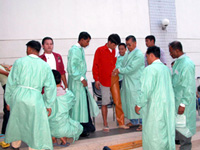 The Sata Foundation fully financed TIDF's workshop to train people from developing countries affected by landmines to produce artificial limbs to landmine victims in those countries. *1
The workshop was held from 15-28 February 2004 in Thailand, with 16 trainees coming from 6 countries (Cambodia, Laos, Myanmar, Nepal, Sri Lanka, and an area of Thailand still replete with active landmines) and a few NGOs (such as Cooperative Orthotic and Prosthetic Enterprise (COPE);*2 the Nepal Disabled Association; the Catholic Office for Emergency Relief and Refugees (COERR); and the American Vietnam Veterans Organization). The trainees were from different religious backgrounds: Buddhism, Christianity, and Hinduism. It was unfortunate that the 2 trainees nominated by the Government of Sierra Leone in West Africa were not able to travel to Bangkok on this occasion; otherwise, there would be Muslim trainees, and from Africa, too.
For more detail, please see the Health Care Section (Artificial Limb) of this website.
(ii) Donation of * to Bethlehem University's Endowment Fund for Teachers
Bethlehem University (http://www.bethlehem.edu) shares the Sata Foundation's mission because:
- This institution of higher education in the Holy Land serves young Palestinians, both Christians and Muslims, male and female, on an equal footing, with students coming from all over the Israeli-occupied West Bank. It, therefore, promotes the "human rights to education" of thousands of young people in the war-torn West Bank.
- The University also protects the "human rights of free speech". The students use the University's courtyard to express their frustrations, hopes and dreams as well as to protest, non-violently, land seizure and other abuses of human rights.
- The University aims to prepare students to support the educational, economic, "health care", social services, natural resources and communication structures of their country. It also has a diploma programme in "Tourism for Peace".
Mr. Sata has also initiated the Friends of Bethlehem University in Japan to help promote the University.
[Sse]
http://www.bethlehem.edu/archives/2004/2004_003.shtml
http://www.bethlehem.edu/archives/2004/2004_050.shtml
(iii)Donation to the Foundation for the Development of International Law in Asia
(DILA): *
DILA (http://asianinternationallaw.org) is the only Asia-wide forum for Asian international lawyers to exchange views on international legal matters of relevance to Asia. There is no subscription fee for DILA membership which is open to all. Through the Asian Yearbook of International Law (Martinus Nijhoff Publishers: Leiden/Boston), DILA informs the world about Asian perspectives on international law that underpins world peace and the international legal order. It subsidizes the purchase of copies of the Asian Yearbook of International Law for users in developing Asian countries that would not otherwise have access to this unique publication.
DILA thus serves to enhance the "understanding among peoples of all cultures, religions and beliefs of the value of peace and respect for universally recognized human rights", which is part of the Sata Foundation's Mission Statement.
DILA's main source of support comes from the Sata Foundation. The Sata Prize (valued at US$2,000 from the year 2005 onward) is awarded annually for the best international law essays by young Asian international legal scholars. The Prize has been awarded to a young law teacher at the City University of Hong Kong,*3 a postgraduate law student from Tajikistan who was then an intern at the International Criminal Tribunal for the Former Yugoslavia in The Hague,*4 and a final-year law student from Kolkata, India.*5 Funding from the Sata Foundation is also used to translate into the English language, for publication in the Asian Yearbook of International Law, papers of outstanding interest and quality which are originally written in an Asian language.*6
(iv)Donation to the Shechen Clinic
For years, the Sata Foundation has been providing financial support to the Shechen Clinic for the poor in an overcrowded suburb of Kathmandu, the capital of Nepal. The Clinic provides quality medical care, regardless of religious, ethnic or political background, to the large community that includes refugees and other people from the mountain regions. Services are provided on a sliding scale cost bases and, in the case of very poor patients, all medical care and medicines are provided at no cost. The Clinic treats over 3,500 patients a month. The services provided include: general medicine, pharmacy, analysis laboratory, tuberculosis (D.O.T.), orthopedic, reproductive health, counseling for HIV and AIDS patients and their family; homeopathy, Tibetan medicine, Tibetan medicine factory, acupuncture, dental clinic, and dental laboratory.
For more detail, please see the Health Care Section (Shechen Clinic) of this Website.
(v)Tsunami Victims Assistance
On 26 December 2004, the Tsunami destroyed 11 countries in Southeast Asia and Africa, with approximately 300,000 lives lost. Mr. Yasuhiko Sata, Chairman of the Board of Directors of the Sata Foundation, made personal pleas to his friends and associates to give assistance in kind and in cash to alleviate the suffering of the victims. The Foundation's Executive Director was in Thailand, one of the countries adversely affected, and was able to provide the correct information on the immediate need of the victims. As a result, several corporations and individuals have contributed donations in cash as well as in kind to help the victims.
(vi)Fundraising
The Sata Foundation has entered into a 3-year copyrights contract, effective from 15 November 2004, with Mr. Sergei Slovachevsky for the exploitation of the DVD recording of Mr. Sergei Slovachevsky's Charity Concert (J.S. Bach Suites Nos. 1, 4, 6 for cello solo), on 29 June 2004 at the Catholic Cathedral in St. Petersburg, Russia, with Mr. Sergei Slovachevsky as the Soloist.
This engagement will, hopefully, assist the Sata Foundation to raise money to support its mission through proceeds from the exploitation of the DVD recording.
(vii) Run for Peace Cycling Rally
The Sata Foundation sponsored the "Run for Peace" Cycling Rally and related events in France on 6 August 2005 to commemorate the 60th anniversary of the atomic bombings of Hiroshima and Nagasaki (on 6 and 9 August 1945, respectively) and to promote the humanitarian mission of the Sata Foundation.
For more detail, see the World Peace Section (Peace Rally) of this Website.
The above are just some examples of the Sata Foundation's activities. The Sata Foundation continues to explore the possibility of expanding its activities to provide health care to people in the least developed countries as well as to promote world peace.
The Sata Foundation has been receiving requests for support all the time. It is up to the Board of Directors to decide on a case-by-case basis whether and to what extent support will be given by the Foundation. The Sata Foundation also refers applicants for support to appropriate charitable organizations which have the mandate and resources to help the applicants.
It is a policy of the Sata Foundation to act as a catalyst for humanitarian action by bringing the plight of needy people to the world public attention, and serving as a channel of funding and support, while cooperating and collaborating with other entities to avoid duplication of efforts. Thus, the Sata Foundation has virtually unlimited scope of involvement in humanitarian activities while, at the same time, maintaining flexibility in controlling the budget to be allocated to each programme of involvement.
*1 One made-to-measure artificial leg made by TIDF costs approx. US$135, and one made-to-measure artificial foot US$ 2.50. In comparison, it would cost approx. US$100-500 per single shipment of artificial limbs to target countries. So, training local trainers to make and fit artificial limbs is more cost-saving than shipping such limbs to target destinations.
*2 A partnership between POWER (a well-known UK-based NGO), the Ministry of Health of Laos, and World Vision (another famous NGO).
*3Mr. Zhao Yun for his essay "Liberalization of Air Transport Services under the Framework of the WTO: Confronting the Challenge of the Twenty-First Century", published in vol. 8 of the Asian Yearbook of International Law.
*4Ms. Takhmina Karimova for her essay "Universal Permissive Jurisdiction for the Violation of Common Article 3 to the Geneva Conventions for the Protection of Victims of War of 12 August 1945", published in vol. 10 of the Asian Yearbook of International Law.
*5Mr. Abraham Mohit for his essay "The Customary Law of International Abductions: Limits and Boundaries", to be published in vol. 11 of the Asian Yearbook of International Law.
*6E.g., "Idealism and Realism in the Post-War Foreign Policy Debate in Japan" by Sakai Tetsuya, first published in Japanese in the March 1996 issue of Kokusai mondai [International Affairs] journal of the Japanese Institute of International Affairs. The English translation appears in vol. 9 of the Asian Yearbook of International Law.
Click here to close this window